So, you’ve decided to aim for the most prestigious nursing badge in India—the AIIMS B.Sc. (Hons) Nursing. Let’s be honest: cracking AIIMS isn't just about how many hours you sit at your desk; it’s about how many hours you spend studying the right things.
With the 2026 entrance exam approaching, the competition is getting tighter, and the "standard" preparation won't cut it anymore. This guide isn't just a list of topics; it’s a strategic breakdown designed to help you navigate the AIIMS B.Sc Nursing syllabus with the precision of a professional.
The AIIMS Edge: What Makes This Exam Different?
Unlike other state-level nursing exams, AIIMS doesn't just test your memory; it tests your application. The exam is designed to filter for students who can handle the rigors of high-stakes medical environments.
Quick Exam Snapshot
| Feature | B.Sc. (Hons) Nursing | Post-Basic B.Sc. Nursing |
|---|---|---|
| Mode | Online (Computer Based Test) | Online (CBT) + Interview |
| Duration | 120 Minutes (2 Hours) | 90 Minutes (Written) |
| Language | English & Hindi | English Only |
| Total Marks | 100 Marks | 70 (Written) + 30 (Personal Assessment) |
| Marking | +1 for Correct; -1/3 for Wrong | +1 for Correct; -1/3 for Wrong |
AIIMS B.Sc. (Hons.) Nursing Syllabus 2026
This syllabus is based on the Class 11 and 12 curriculum and is the standard for the 4-year degree entrance.
| Subject | Topics Covered |
|---|---|
| Biology | Role of Plants in Human Welfare, Mineral Nutrition, Prokaryotic & Eukaryotic Cells, Structural Organization of Cell, Elements and their Function, Classification Binomial and Nominal Nomenclature, Five Kingdom Classifications, Cell Theory, Mendel’s Law of Inheritance. |
| Physics | Communication Systems, Magnetic Effect of Current & Magnetism, Electronic Devices, Dual Nature of Matter, Alternating Current, Electromagnetic Induction, Electromagnetic Waves, Atoms and Nuclei, Optics, Current Electricity, Electrostatics. |
| Chemistry | Chemical Kinetics, Polymers, Biomolecules, General Principles & Processes of Isolation of Elements, P-Block Elements, D & F-Block Elements, Coordination Compounds, Organic Compounds containing Nitrogen, Electrochemistry, Solid State, Chemistry in Everyday Life, Solutions, Surface Chemistry, Phenol & Ester, Ketones and Carboxylic Acids, Alcohols. |
| General Knowledge | History, Science, Geography, Culture, General Policy, Scientific Research, Current Affairs. |
AIIMS Post-Basic B.Sc. Nursing Syllabus 2026
This syllabus is designed for candidates who already hold a GNM diploma and focuses on professional nursing practices.
| Subject | Key Topics & Focus Areas |
|---|---|
| Fundamentals of Nursing | Basic care (hygiene, safety), infection control (sterilization, precautions), vital signs (TPR, BP), medication administration (routes, safety), ethics & legal aspects, documentation. |
| Medical-Surgical Nursing | Cardiovascular (HTN, MI, HF), Respiratory (asthma, COPD), Neurology (stroke, epilepsy), Endocrine (diabetes, thyroid), GI (ulcer, hepatitis), Renal (UTI, failure), Oncology, Perioperative care, Emergency & ICU. |
| Physiology & Pharmacology | Body systems & homeostasis, pharmacokinetics & dynamics, system-wise drugs (analgesics, antihypertensives), antimicrobials & chemotherapy, drug safety & interactions. |
| Obstetrics Nursing | Antenatal care, labor & delivery, postnatal care, newborn care, obstetric emergencies (PPH, eclampsia). |
| Pediatric Nursing | Growth & development, childhood diseases, immunization schedule, pediatric emergencies, child nutrition, neonatal care. |
| Community Health Nursing | Health concepts, prevention levels, health education, epidemiology, national programs (MCH, FP), environmental health, healthcare system (PHC, ASHA). |
| Psychiatric Nursing | Mental health concepts, therapeutic communication, disorders (mood, anxiety, psychotic), psychiatric drugs, counseling & rehabilitation. |
| Professional Trends | History of nursing, ethics & law, modern trends (Evidence-Based Practice, technology), education & research, INC & organizations, career pathways. |
AIIMS Post-Basic B.Sc. Nursing: For the Professionals
If you are a GNM diploma holder looking to upgrade, your syllabus shifts from pure science to clinical application.
Key Clinical Areas:
- Medical-Surgical Nursing: Managing chronic conditions like Diabetes, Hypertension, and COPD.
- Obstetrics & Midwifery: Pregnancy stages, labor complications, and neonatal care.
- Community Health Nursing: PHC structures, National Health Programs (NHM), and Epidemiology.
- Mental Health: Therapeutic communication and common psychiatric disorders.
Beyond the Syllabus: How to Actually Prepare
1. The "Mistake Vault" Strategy
Stop solving 100 MCQs and moving on. Maintain a "Mistake Vault"—a notebook where you write down every question you got wrong and why. Was it a silly error? Or a conceptual gap? Review this vault every Sunday.
2. Master the "Screen Stamina"
Since AIIMS is a Computer-Based Test (CBT), your eyes and brain need to be comfortable reading from a screen for 120 minutes. At least 2 months before the exam, stop using physical books for mock tests. Use online portals to build screen stamina.
3. The 3-Step Revision Cycle
- Daily: 30 minutes of Active Recall (closing your eyes and explaining a topic to yourself).
- Weekly: Full-length Mock Test every Saturday.
- Monthly: Deep-dive into your "Mistake Vault."
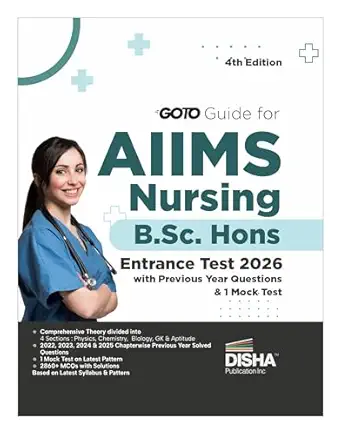
Disha Go To Guide for AIIMS Nursing B.Sc. Hons. Entrance Test 2026 with Previous Year Questions & 1 Mock Test 4th Edition

Disha Target AIIMS Nursing B.Sc. Hons. Entrance Test 2026 - 10 Mock Tests with 2022 - 2025 Previous Year Solved Papers 3rd Edition

Arihant B.Sc Nursing Entrance Exam Guide 2026
A Realistic Daily Routine for Top Rankers
Consistency is better than intensity. Don't study for 15 hours one day and zero the next.
| Time | Activity | Focus |
|---|---|---|
| 07:00 AM – 09:30 AM | The "Heavy Lift" | Physics/Chemistry Numerical Practice. |
| 10:30 AM – 01:30 PM | Concept Building | Biology NCERT deep-reading and notes. |
| 03:00 PM – 05:00 PM | Active Practice | Solving 50–100 MCQs (Timed). |
| 06:00 PM – 07:30 PM | The "Easy Wins" | General Knowledge & Current Affairs. |
| 09:00 PM – 10:00 PM | Review | Analyzing the day's mistakes. |
Final Thoughts: The Mindset of a Nurse
Remember, you aren't just studying to pass an exam; you are studying to save lives. When the Physics numericals get tough or the Organic mechanisms seem impossible, remember the "why" behind your "what."
The white coat is earned, not given. Stay disciplined, keep your NCERT close, and we’ll see you at AIIMS in 2026.
Ready to start? Pick one topic from Biology today and master every diagram in it. Small wins lead to big results.